The first wave
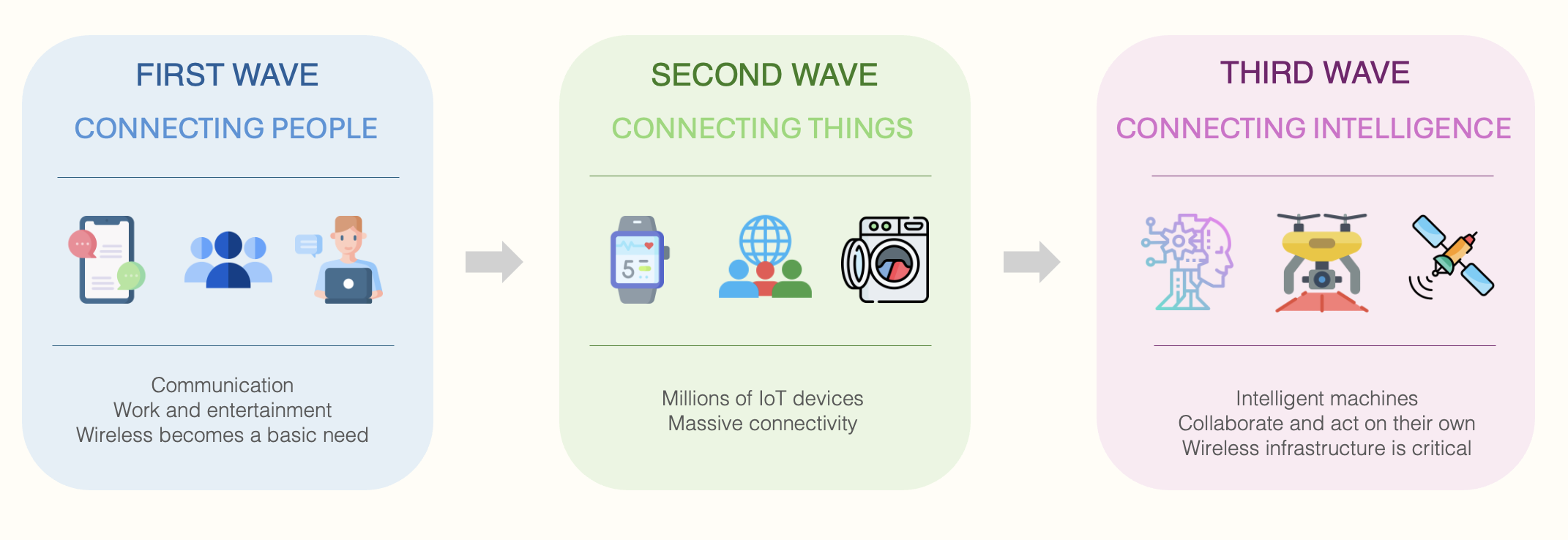
Connecting People
In 2010, I was still living in Vietnam. Around that time, Wi-Fi was beginning to appear in many homes around me. People started chatting and messaging one another more often than ever before. Video calls came later. My parents live in a small city, and we used to keep in touch through traditional phone calls. I still remember some of my first video calls with them. Seeing each other while we talked felt different. Not long afterwards, we more or less stopped making traditional calls.
Then everything moved quickly.
Video calls became more reliable. Online gaming, P2P applications and video streaming became common. Smartphones changed how we communicated, worked and entertained ourselves. Over time, wireless connectivity became a basic need. We stopped thinking about the network and simply expected it to work.
Perhaps that is one of the greatest successes of wireless communications. For many of us, it felt as though wireless had largely completed its first mission: connecting people.
The second wave
Connecting Things
Around 2015 or 2016, the term “Internet of Things” was mentioned everywhere. The ambition was to connect almost everything around us.
To be fair, “connecting everything” sounded rather vague at the time. Looking back now, the early examples were relatively simple, which is connecting us to smartwatches, sensors and other devices in different settings. However, even these apparently simple applications created a major challenge. The number of connected devices was expected eventually to far exceed the human population. Supporting this scale became an important part of the 5G vision, and it remains part of the path towards 6G.
How successful have we been? I do not know exactly how to answer this, but we have certainly achieved some success.
From my perspective as an ordinary user, current networks work well most of the time at a fairly low price. I can easily work remotely using my phone. In the UK, I pay around £10 to Vodafone for 10 GB of mobile data per month. In Vietnam, I can pay roughly £2 per month and receive 3 GB of data per day over LTE or 5G. Wow!
When you see that a technology is widely available at a reasonable price, you know that it has been successful.
However, I do not think we are ready for the next wave of technology.
The next wave
Connecting Intelligence
If you had asked me three years ago how quickly AI would progress, I might have doubted it. Even now, it still feels unreal to see robots being trained to perform many complex tasks. It may only be a matter of time before they become commercially available and perform some tasks better than humans. At the time of writing, large AI models are increasingly being distilled into smaller ones that can be embedded in different devices. This means that the things around us may soon possess some degree of intelligence.
We can already see early examples in autonomous vehicles. The next generation of embodied AI systems may appear in many different forms and perform tasks that we have not yet imagined.
In this vision, wireless connectivity will become essential infrastructure. Its mission and the challenges it must address will be greater than those of the early IoT era.
Challenge 1 — Increasing Scale
The number and variety of intelligent machines will become enormous because of their almost unlimited potential.
Challenge 2 — Increasing Data Intensity
The way intelligent machines exchange information will be very different from human communication. When two people talk, we normally exchange a single stream of words. Intelligent machines may exchange information in many forms simultaneously, including video, sound, sensing data, maps and learned features.
Some of this information can be processed locally and may never need to cross the network. In the most demanding applications, however, intelligent machines may need to share large amounts of multidimensional information at very high speeds. The network will need to meet those demands.
Challenge 3 — Increasing Mobility and Reach
Mobility and the range of possible operating environments make the problem even more challenging. In my imagination, there is essentially no limit to where intelligent machines could be deployed. At the early stage, they may operate in remote or hazardous places where sending people would be difficult or dangerous. This means that the necessary communication infrastructure must be available wherever these machines operate.
Many earlier connected systems simply sent sensor measurements or streamed video to a human operator. They remained under fairly strict human control. In the next era, intelligent machines may collaborate and make decisions with less continuous human intervention. Human oversight will still remain important, but the communication network may become part of the loop connecting perception, decision and physical action.
Imagine some intelligent machines working in the Arctic. A satellite link might help keep them connected. But what happens when there is a whole fleet (hopefully not with weapon) working and coordinating there? How do we provide enough capacity? How do the machines exchange information quickly enough to reach their full potential? How do we keep the system reliable and safe when terrestrial infrastructure is unavailable?
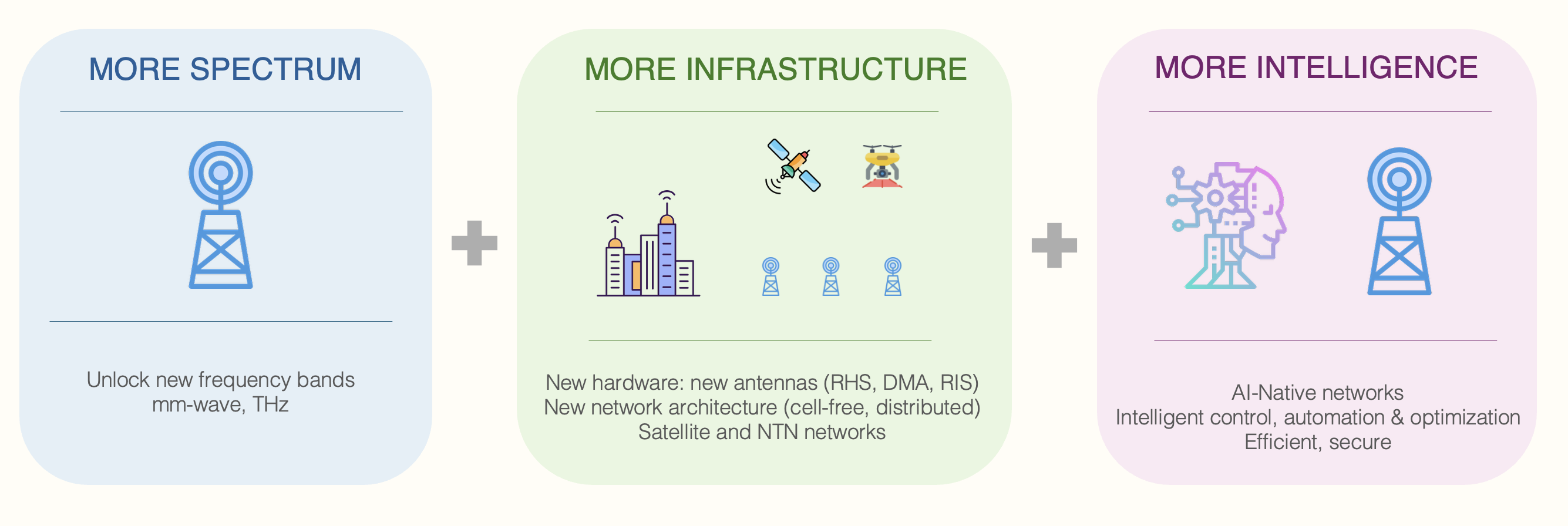
Over years, the goals of wireless communications have always been broadly the same: improved coverage, higher capacity and better energy efficiency. The upcoming wave will push all these requirements extremely further. Can today’s networks support these systems? To some extent, yes. However, my concern is that AI is advancing much faster than wireless communications. If this gap continues to widen, wireless connectivity could become a bottleneck. There are three broad categories of actions:
Action 1 — Smarter Networks
Future networks will become increasingly complex. AI has already proved useful in helping networks make better decisions across different tasks. This is happening in 5G, and I expect 6G software to integrate AI more deeply.
Action 2 — Unlock New Radio Resources
More connected devices and richer applications will increase the demand for network capacity. This motivates the use of additional spectrum, including upper-mid bands, millimetre-wave frequencies and sub-terahertz bands.
Moving to a higher frequency is like opening a wider road. It can provide more space for traffic, but it also creates new challenges. Radio propagation behaves differently at these frequencies. New antennas, radio hardware and semiconductor technologies may be required. Deployment costs and spectrum regulations must also be considered.
Action 3 — Evolve the Physical Infrastructure
No matter how intelligent the software becomes, it cannot remove the physical constraints of radio propagation. Future wireless systems will therefore need new antenna architectures that provide greater spatial control without unreasonable size, cost, power consumption or hardware complexity. Dynamic metasurface antennas and reconfigurable intelligent surfaces are 2 examples of a new generation of adaptable radio hardware.
Network architecture must also evolve. Cell-less, or cell-free, massive MIMO is one promising example that has been discussed recently.
Satellites and other non-terrestrial platforms will also be extremely important. They can form part of the solution for communities and locations that remain beyond reliable terrestrial coverage. Importantly, they will also play a strategic role in emergency response and national communications resilience.
These three directions will also create enormous standardisation challenges. Standards organisations, network operators, equipment manufacturers, governments and spectrum regulators will need to find a common voice.
Looking ahead, I cannot predict exactly where wireless technology will be in 10 years. Connectivity has always been an enabling technology, so its evolution will depend largely on how other technologies develop and the capabilities they require. I grew up in a small town and have been fortunate to witness many remarkable tech developments, including wireless communications. Sometimes, I miss the simplicity of the old days. At the same time, I am curious about the next transformation, and I hope I can contribute to it in some way.
If you have something to share, please reach me at son.v.dinh@warwick.ac.uk.